Archives: FAQs

Is there an acoustical advantage to hanging a fabric-wrapped acoustic panel horizontally or vertically on a wall?

No. The orientation of our fabric-wrapped acoustic panels does not affect their sound absorption performance. Our high-density acoustic panels deliver the same acoustical benefits, regardless of the direction they are mounted on walls.

What matters most is having adequate coverage in your space to reduce echo and reverberation. In furnished rooms where people sit or stand, panels should generally be placed a bit higher on the wall or near ear level. In spaces with bare reflective walls, you may benefit from placing sound absorbing panels lower on a wall. Taller wall areas may also benefit from adding coverage in the upper areas. The goal is to distribute sound-absorbing panels throughout the space to create balanced sound control.

Placement Tips:

  • Rooms with furniture and people: Position panels near ear level.
  • Rooms with bare walls or minimal furnishings: Position panels lower on a wall with optional coverage added in upper wall areas.

Fabric Note: Some fabric patterns are directional and may look different when rotated. Always check pattern orientation before installation. Consult our Acoustics America team for more assistance.

Interested in ordering fabric-wrapped acoustic panels for your space but unsure where to begin? Complete our inquiry form and our customer support team will answer your questions and walk you through the ordering process.
How much Loctite Powergrab Adhesive do I need to apply to each impaling clip included with my fabric-wrapped acoustic panel purchase?

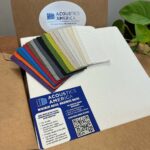
We recommend a golf ball sized amount of Loctite Powergrab Adhesive to each impaling clip.  According to our installation guide:

  • A 120″ x 48″ acoustic panel includes 10 impaling clips
  • A 60″ x 48″ fabric-wrapped panel includes 6 standard impaling clips

A single 9 oz. tube typically covers 10-15 impaling clips.

Unsure how many 9 oz. tubes of Loctite you need for your acoustic panels? Complete our inquiry form and our customer support team will answer your questions and walk you through the ordering process.
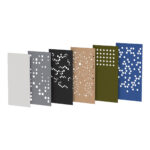
How do I clean my polyester recycled felt purchase?

Our polyester acoustic products are cleanable with mild cleaners. You can find more information in our polyester acoustics cleaning guide.

Does polyester felt absorb sound?

Yes! The polyester fibers trap and dissipate sound energy, minimize reverberation and echo.  Polyester felt is an effective material for sound absorption in a variety of settings, including but not limited to offices, restaurants, houses of worship, home theaters and auditoriums.

Are polyester (PET) acoustics really made from recycled material?

Yes they are!  They are 100% recyclable and made from 60% recycled material.  In addition to being environmentally friendly, recycled polyester felt is low-VOC and odorless.

What is PET?

PET or polyester felt is made from recycled PET plastic (Polyethylene Terephthalate).  This eco-friendly material provides excellent sound management, making it ideal for a variety of acoustic projects.  Polyester felt products are lightweight, durable, visually appealing and easy to install and maintain.  PET acoustics are a smart choice for diverse settings.

Do you offer custom shape acoustic panels?

Yes. We offer custom shape acoustic panels in our 1-inch polyester core material. They can be wrapped or colored polyester. Give us a call to discuss further at (800) 569-4907 or complete our inquiry form and our customer support team will answer your questions and walk you through the ordering process.
What are the differences between your polyester and fiberglass cores?

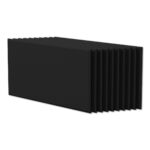
Polyester and fiberglass acoustical panels differ in material composition, performance, and application. When choosing between the two, consider your specific acoustic needs, environmental preferences, and aesthetic goals of your space. Both options can effectively enhance acoustics, but each excels in different scenarios.

Advantages of Fiberglass Fabric Wrapped Core Panels:

  • Best Absorber
  • Proven Solution, industry standard for noise reduction
  • Balance absorption across full frequency spectrum
  • Lower cost
  • Available with any fabric and any color

Advantages of Polyester Fabric Wrapped Core Panels:

  • Tackable, able to be used as a bulletin board
  • Impact-resistant, (i.e., gymnasiums)
  • Moisture-resistant (i.e., indoor swimming pools)
  • Eco-Friendly, derived from recycled materials
  • Available in any custom shape
  • Available with any fabric and any color

Am I able to use your acoustic panels as bulletin boards?

Our polyester core fabric wrapped panels are tackable and able to be used as bulletin boards. We do not recommend using the fiberglass core fabric wrapped panels as bulletin boards.

What are Bass Traps?

Bass Traps are an acoustical treatment that reduces sound issues in the corners of rooms where walls meet, and sound is captured. They are specifically designed to address low frequency standing wave issues, which can create unpleasant or distorted sounds. (Standing waves are defined as the interference of two identical waves, traveling in opposite directions).

By installing Bass Traps, standing waves are reduced, and excessive room reverberation is also reduced. Bass traps are mostly commonly used in recording studios, home theaters, podcast studios, and rooms where loud music and low-end bass sounds exist.

Independently verified
726 reviews