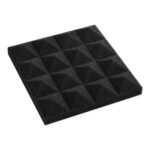
NRC, or Noise Reduction Coefficient, measures how much sound a material absorbs rather than reflects back into a room. It is calculated by measuring the sound absorption coefficient at 250, 500, 1,000 and 2,000 Hz (sound frequencies) and averaging the results. A 0.00 means the material reflects nearly all sound. A 1.00 means the material absorbs nearly all sound within those frequency ranges. Some laboratories calculate NRC values greater than 1.0 due to the effects of the sides and/or back being exposed relative to the surface face area. While values greater than 1.0 are a topic of debate among acoustical engineers, the higher the NRC value, the more sound is absorbed, and the more echo is reduced.
It is important to note that NRC measures sound absorption within a room. It does not measure sound blocking between rooms.
Hard surfaces like concrete, glass and drywall have very low NRC ratings. This is why an office without sound-absorbing materials can sound hollow and echoey. The higher the NRC rating, the more effective the material is at absorbing sound, reducing echo and reverberation.
When acoustic products are added to offices, classrooms, churches, and shared spaces, they reduce unwanted sound reflections, improve speech clarity and create a quieter, more comfortable environment.